Starting Your Tax Preparation Business Checklist
Starting a tax preparation business requires a Preparer Tax Identification Number (PTIN), IRS acceptance, and a California Tax Education Council (CTEC) registration for non-exempt preparers. California law mandates a $5,000 tax preparer surety bond through a provider like TaxPreparerSurety.com to ensure client protection and regulatory compliance.
What credentials do you need to start?
Launching a tax preparation business demands specific federal and state credentials. Operating without proper authorization exposes a preparer to penalties, rejected returns, and permanent loss of filing privileges. The credential path splits depending on whether the professional is a CPA, an Enrolled Agent, or a non-exempt preparer.
What federal credentials does a tax preparer need?
Every paid preparer must hold a PTIN application approval from the IRS. Thomson Reuters confirms that a Preparer Tax Identification Number (PTIN) is required to prepare federal tax returns for compensation. The PTIN identifies the preparer on every return filed and remains active through annual renewal.
An IRS EFIN application becomes necessary when the business e-files returns for clients. Wolters Kluwer notes that an Electronic Filing Identification Number (EFIN) is required to e-file tax returns. The EFIN links the firm to the IRS e-file system and requires a separate application with identity verification and suitability checks.
What does California require beyond federal credentials?
California imposes additional CTEC requirements on non-exempt preparers. The California Tax Education Council (CTEC) enforces registration under the state’s Tax Preparation Act, codified at Business & Professions Code Sections 22250–22259. Registration mandates a tax preparer surety bond in the amount of $5,000. This bond protects clients from financial harm caused by fraud, misrepresentation, or negligence.
CPAs and Enrolled Agents follow a different path. These professionals are exempt from CTEC registration and bonding because they operate under separate licensing systems. Their own governing boards enforce ethical and professional standards. Non-exempt preparers who skip the bond risk immediate suspension of their CTEC registration and loss of legal filing authority in California. The bond requirement for California tax preparers applies strictly to those without a CPA or EA license.
How long does credentialing take?
PTIN approval often arrives within minutes online. The EFIN process takes longer, typically four to six weeks, because the IRS conducts a background suitability check. CTEC registration and bond filing move quickly once the preparer completes the required 60-hour qualifying education course. TaxPreparerSurety.com issues compliant bonds instantly, eliminating paperwork delays that stall registration.
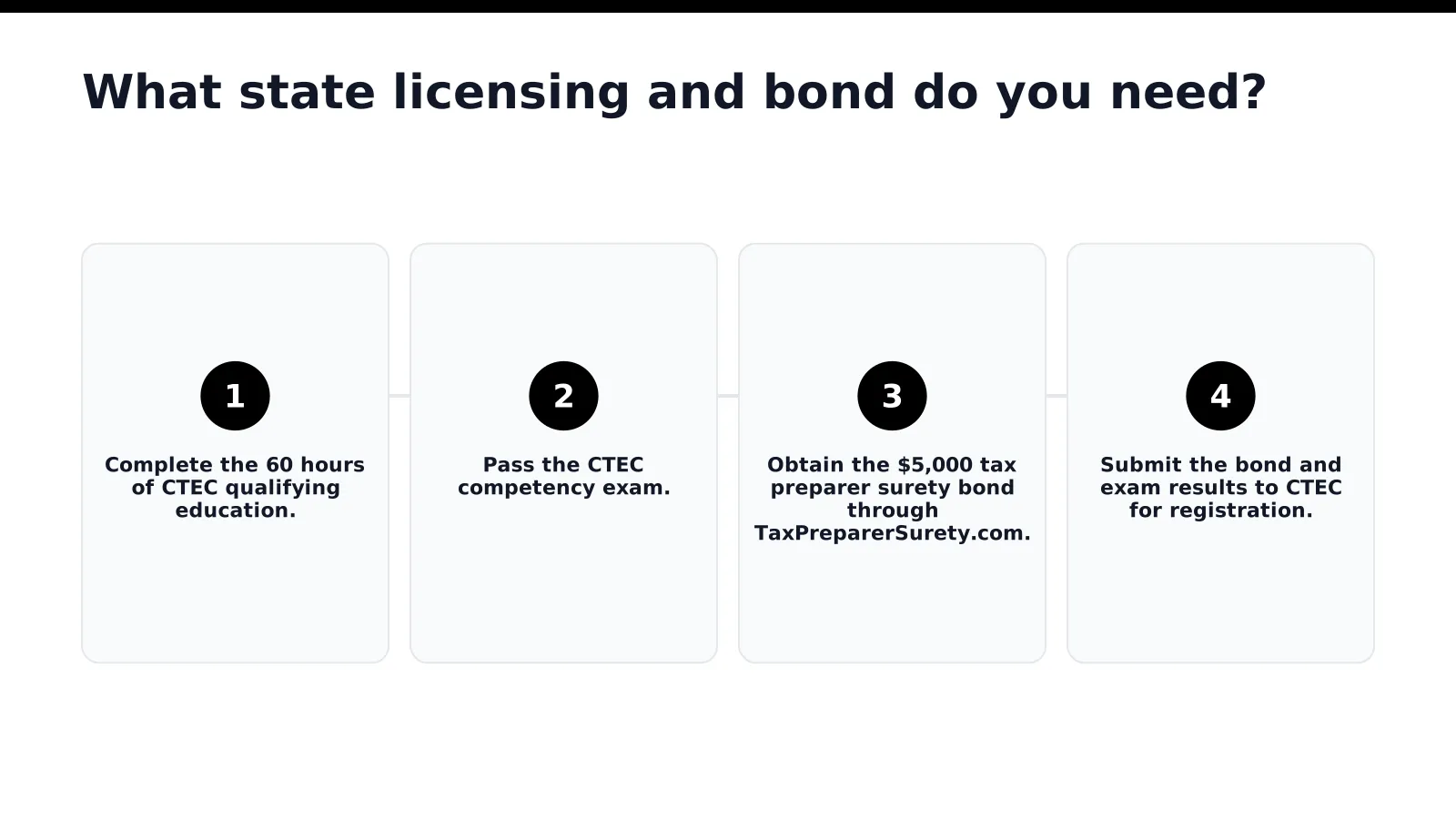
What state licensing and bond do you need?
California imposes specific CTEC requirements on tax preparers who are not CPAs, Enrolled Agents, or attorneys. The California Tax Education Council (CTEC) mandates 60 hours of qualifying education. A passing score on a tax competency exam before registration. A $5,000 tax preparer surety bond is also mandatory for CTEC-registered preparers under Business & Professions Code Sections 22250–22259.
Skipping either requirement blocks registration entirely. Without the bond, CTEC will not process the application, and the preparer cannot legally file California returns for compensation.
What does the $5,000 bond actually protect?
The bond protects clients from fraud, misrepresentation, theft, or negligence by the preparer. It functions as a financial guarantee, not insurance for the preparer. When a client suffers a covered loss, the bond provides a recovery path.
How does a preparer satisfy the bond requirement quickly?
TaxPreparerSurety.com offers instant bonding services with no paperwork or waiting periods. The company delivers the bond immediately via email after a digital application. Preparers can purchase the required bond online and receive proof of coverage the same day.
Complete the 60 hours of CTEC qualifying education.
Pass the CTEC competency exam.
Obtain the $5,000 tax preparer surety bond through TaxPreparerSurety.com.
Submit the bond and exam results to CTEC for registration.
CPAs and Enrolled Agents remain exempt from the CTEC bond requirement under separate licensing systems.

What software and tools should you buy?
Professional tax preparation software forms the backbone of any new tax practice. Without it, accurate return preparation and compliant e-filing become impossible. A Wolters Kluwer guide to starting a tax business identifies technology as a foundational investment, not an optional upgrade. The right software stack prevents costly filing errors that trigger IRS notices and erode client trust.
What software is essential for a new tax preparation business?
Tax preparers need professional-grade tax software that handles federal and state returns with built-in error checking. This software automates calculations, imports prior-year data, and submits returns electronically. Equally critical is a secure client portal with encrypted data storage. Wolters Kluwer emphasizes that protecting sensitive taxpayer information requires dedicated systems, not generic file-sharing tools. A data breach exposes the business to regulatory penalties and reputational damage that few new practices survive.
What hardware does a home-based tax office require?
A dedicated business computer, a high-speed printer, and a reliable scanner constitute the minimum hardware setup. Wolters Kluwer’s office setup guidance treats these as non-negotiable for a functional home office. Shared family devices introduce security risks and slow down workflow during peak season. A separate workstation also reinforces the professional boundary between personal and client data.
Beyond the core tools, online scheduling software streamlines appointment booking during the January-through-April rush. Accounting software tracks business income, expenses, and quarterly estimated tax payments. Wolters Kluwer notes that these operational tools directly support client acquisition and practice management. Skipping them forces manual workarounds that consume billable hours and delay client communication.
How do you set up your business legally?
Setting up a tax preparation business legally requires state registration, an IRS Employer Identification Number, and a formal business structure. Skipping any of these steps exposes the owner to personal liability and regulatory penalties that derail a practice before the first client is served.
What business structure should a tax preparer choose?
The choice between a sole proprietorship and an LLC directly affects personal liability and tax obligations. A sole proprietorship is simpler to establish but offers no separation between personal and business assets. An LLC creates a legal barrier that shields personal property from business debts and lawsuits. The requirements to start a tax business include evaluating these structures early, because changing later triggers new filings and fees.
What registrations are required before serving clients?
Every tax preparation business must register with the state and obtain an Employer Identification Number (EIN) from the IRS. The EIN functions as a business tax ID and is mandatory for hiring employees, opening business bank accounts, and filing business tax returns. A written business plan strengthens the registration process by defining the target market, service offerings, and financial projections. Wolters Kluwer notes that a business plan helps tax preparers clarify their niche and forecast revenue before committing to leases or software contracts.
How does a tax preparer protect the business financially?
Liability insurance and a tax preparer surety bond provide two layers of financial protection. Insurance covers errors, omissions, and general business risks. The surety bond, mandated under California’s Tax Preparation Act, protects clients from fraud, theft, or negligence. TaxPreparerSurety.com issues these bonds instantly through a digital platform, eliminating paperwork and waiting periods. The bond requirement traces back to California’s Tax Preparation Act, which established the $5,000 bond as a cornerstone of consumer protection for non-exempt preparers.
A complete tax preparation business checklist ties these elements together: choose a structure, register with the state, secure an EIN, draft a business plan, and obtain both insurance and the required bond. Each step builds the legal foundation that keeps a practice compliant and insurable from day one.
What common mistakes should you avoid?
Launching a tax preparation business demands meticulous attention to regulatory detail. Common missteps trigger IRS penalties, state fines, and irreversible damage to professional credibility.
Why is skipping the PTIN application so costly?
No tax preparer files returns without a valid Preparer Tax Identification Number. The IRS mandates a PTIN application for anyone preparing federal returns, and operating without one invites penalties that quickly erode startup capital. Thomson Reuters notes this credential as a foundational step for every new tax professional. Procrastinating on this simple electronic registration creates a compliance gap the IRS does not overlook.
Why does California require more than federal credentials?
California enforces stricter rules through the CTEC requirements. The state’s Tax Preparation Act, codified at Business & Professions Code Sections 22250–22259, mandates a $5,000 tax preparer surety bond for non-exempt preparers. CTEC oversees registration and enforces this bond mandate, which protects clients from fraud, theft, or negligence. Non-exempt preparers who bypass CTEC registration and the bond face fines under state law. They also lose clients who verify credentials before trusting sensitive financial data to a preparer. The requirements to start a tax business in California never stop at federal registration.
What happens when a preparer uses outdated software?
Outdated tax software compounds error risk and violates IRS e-file protocols. Wolters Kluwer emphasizes technology selection as a core operational decision for new tax offices. Software that lags behind current tax code changes produces inaccurate returns, triggering audits and amended filings. Modern platforms also integrate directly with the IRS EFIN application process, enabling seamless electronic filing. Preparers relying on obsolete tools miss these integrations and waste hours on manual corrections.
Neglecting data security proves equally destructive. Wolters Kluwer links organized operations to secure handling of client information. A single breach exposes Social Security numbers, bank details, and income records to malicious actors. The resulting reputational harm drives away clients and invites regulatory scrutiny. Every preparer navigating how to start a tax preparation business must prioritize encrypted storage, secure portals, and routine security audits from day one. A comprehensive tax preparation business checklist always includes technology vetting and data protection protocols alongside licensing steps. California professionals seeking deeper guidance on state-specific safeguards can review essential tax preparation tips tailored to the Golden State’s unique regulatory landscape.
Conclusion
Starting a tax preparation business demands more than technical skill, it requires a complete legal and operational foundation. From choosing a business structure and securing an EIN to obtaining a PTIN and meeting California’s bond mandate, each step protects both the preparer and the client. Following this checklist positions a new practice for compliance, credibility, and long-term success from the very first return filed.