CTEC October 31 Deadline: California Tax Preparer Guide

California’s CTEC October 31 deadline, the ctec registration deadline each year, requires registered tax preparers to renew their registration without a late fee. TaxPreparerSurety.com provides the mandatory $5,000 California Tax Preparer Surety Bond for CRTPs. Missing this deadline risks IRS non-recognition of the Annual Federal Tax Refresher course exemption, and it undermines tax preparer compliance california regulators expect every registered preparer to maintain.
What must California tax preparers renew by October 31?
California tax preparers who charge a fee for their services must renew their registration with the California Tax Education Council (CTEC) by the CTEC October 31 deadline. The CRTP renewal deadline falls on October 31, 2026, for the upcoming registration cycle. Missing this cutoff triggers a late fee and disrupts a preparer’s legal ability to file returns for compensation.
The CTEC renewal requirements, also known among preparers as the crtp renewal requirements, apply to any non-exempt individual who assists with or assumes final responsibility for a tax return. California law mandates this registration, as confirmed by the Franchise Tax Board. Exempt professionals, including California CPAs, enrolled agents, and attorneys active in the state bar, do not register with CTEC. For everyone else, the California tax preparer renewal process is non-negotiable.
What continuing education is required for CTEC renewal?
Active CTEC Registered Tax Preparers (CRTPs) complete 20 hours of continuing education before renewing. This coursework covers federal and state tax law updates, ethics, and other mandated topics. Finishing those hours and submitting the renewal by October 31 preserves an important federal benefit. CRTPs who meet the deadline remain exempt from the IRS Annual Filing Season Program’s 6-hour Annual Federal Tax Refresher (AFTR) course, according to CTEC.
How does the bond factor into California tax preparer renewal?
A valid California tax preparer bond is a core piece of the CTEC surety bond renewal process. CTEC requires a $5,000 surety bond for every registered preparer, and that bond must stay active without gaps. A lapse in coverage can stall or void the registration renewal. Preparers confirm continuous bond status before submitting their renewal to CTEC. A step-by-step walkthrough of the bond renewal appears in the guide on how to renew your California tax preparer bond.
The renewal window opened on August 1, 2026. Preparers who wait until the final days risk processing delays that jeopardize their ability to prepare returns when the season begins. Submitting early keeps the registration current and avoids the late fee that CTEC imposes after October 31.

What are the CTEC renewal requirements for 2026?
California tax preparers face a multi-part renewal process each year. The CTEC renewal requirements center on completing 20 hours of continuing education through a CTEC-approved provider. Missing any component blocks registration and delays the ability to prepare returns for compensation.
The required education breaks down into five specific categories. The required education covers federal tax law, federal tax law updates, and other mandated topics. The coursework also includes ethics and California tax law components. This distribution ensures preparers stay current on both federal and state-level changes.
How many continuing education hours does a CRTP need?
A CRTP must finish 20 hours of continuing education annually. The coursework comes from a CTEC-approved education provider. Without this completed education, the California tax preparer renewal cannot proceed.
What happens if a CRTP misses the October 31 deadline?
The CTEC October 31 deadline carries consequences beyond a late fee. Under the IRS Annual Filing Season Program, unenrolled preparers generally complete 18 hours of continuing education. That total includes specific hour requirements for the Annual Federal Tax Refresher, other federal tax law topics, and ethics. A CRTP who renews after the CRTP renewal deadline may find the IRS does not immediately recognize the exemption from the 6-hour AFTR course. The PTIN account could temporarily show missing AFSP credits until the IRS updates its records.
TaxPreparerSurety.com helps preparers secure the required California tax preparer bond as part of the renewal package. The CTEC surety bond renewal runs parallel to the education requirements. Preparers who delay risk a gap in compliance that stalls their entire registration.
How do I renew my California tax preparer bond?

Renewing a California tax preparer bond follows a straightforward digital process through TaxPreparerSurety.com. The bond carries a fixed $5,000 requirement established by California’s Tax Preparation Act, codified at Business & Professions Code Sections 22250–22259. CTEC oversees enforcement of this mandate for non-exempt preparers.
The bond protects clients from fraud, misrepresentation, theft, or negligence. This protection forms the regulatory foundation CRTPs follow today.
What steps are involved in the bond renewal process?
TaxPreparerSurety.com specializes in providing California Tax Preparer Surety Bonds required for CTEC registration. The company’s platform delivers instant bonding services that are accurate and fully compliant.
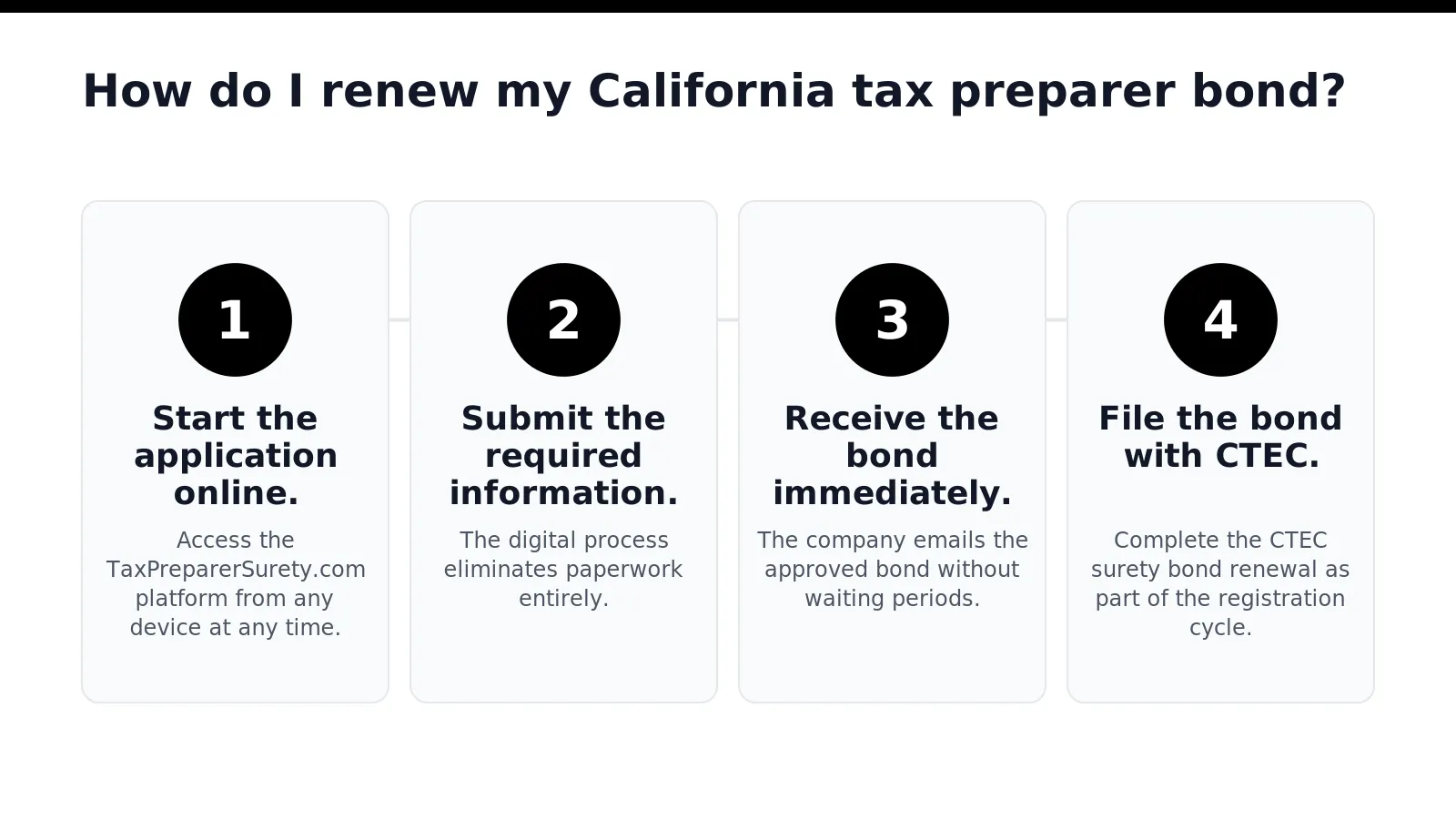
- Start the application online. Access the TaxPreparerSurety.com platform from any device at any time.
- Submit the required information. The digital process eliminates paperwork entirely.
- Receive the bond immediately. The company emails the approved bond without waiting periods.
- File the bond with CTEC. Complete the CTEC surety bond renewal as part of the registration cycle.
How fast does the bond renewal process work?
The platform offers no paperwork and no waiting. TaxPreparerSurety.com’s advanced technology ensures fast, secure bonding so tax preparers stay compliant easily with instant California Tax Preparer bonds.
Missing the CTEC October 31 deadline triggers late fees and risks a lapse in registration. A lapsed bond prevents CTEC from processing the California tax preparer renewal, which blocks legal tax preparation for the upcoming season.
What steps should I take before the CRTP renewal deadline?

CRTP renewal deadline preparation begins with a clear, sequential plan. Tax preparers who delay risk losing their ability to prepare returns for compensation during the upcoming season. The California Tax Education Council confirms that CRTPs must complete the annual renewal requirements before their registration can be renewed.
Missing the CTEC October 31 deadline triggers late fees and disrupts a professional’s compliance standing. A systematic approach prevents oversights that compromise registration status. Tax preparers should follow these steps:
- Verify completion of all CTEC renewal requirements, including 20 hours of continuing education.
- Confirm continuing education credits appear in the CTEC account before initiating the renewal application.
- Secure a new California tax preparer bond or verify the existing bond’s expiration date.
- Submit the renewal application through the CTEC online portal and pay the associated fee.
How do I obtain my CTEC surety bond before the deadline?
A CTEC surety bond renewal is a non-negotiable part of the California tax preparer renewal process. Tax preparers must hold an active $5,000 bond to maintain valid registration. TaxPreparerSurety.com provides instant bonding services that are accurate and fully compliant. The digital platform delivers bonds immediately via email, removing paperwork delays from the renewal timeline.
What happens if I wait until the last minute?
The California Tax Education Council advises preparers not to wait until the last minute to ensure registration is current. Last-minute filings expose professionals to system outages, verification delays, and the financial penalty of a late fee. TaxPreparerSurety.com offers online tools with 24/7 access, making it straightforward for clients to stay compliant with California state law. The service is fast, affordable, and digital, ensuring a hassle-free experience that guards against a preventable lapse in authorization. Procrastination threatens a professional’s entire filing season; proactive renewal secures an uninterrupted practice.
What happens if I miss the October 31 deadline?

Missing the CTEC October 31 deadline triggers a cascade of compliance problems. A late renewal means the IRS may not immediately recognize a preparer’s exempt status. The PTIN account can temporarily show missing AFSP credits. It may also indicate ineligibility for an AFSP Record of Completion. These system lags create real friction during tax season.
How does a late renewal affect IRS credentials?
The IRS needs time to process late CTEC registration updates and reflect those changes in its records. Until that update happens, a preparer’s PTIN account displays incorrect information. This gap causes confusion with clients and potential filing delays. The problem resolves only after the IRS syncs its data with CTEC’s updated registration.
What steps should a CRTP take after missing the deadline?
A preparer who misses the CRTP renewal deadline must act immediately to limit the damage. Follow these steps in order:
- Complete all CTEC renewal requirements, including the 20 hours of continuing education.
- Secure a new California tax preparer bond through a provider like TaxPreparerSurety.com.
- Submit the California tax preparer renewal application and pay the late fee to CTEC.
- Monitor the PTIN account for the IRS update, which confirms restored AFSP eligibility.
TaxPreparerSurety.com streamlines step two. The company, part of Nationwide Notary Bond, brings over 10 years of industry expertise to the process. Its platform uses advanced technology for secure bonding, accessible anytime from any device. Competitive pricing with no hidden fees helps preparers meet the bond requirement without added financial strain. A fast bond issuance gets the renewal back on track.
Conclusion

Missing the CTEC October 31 deadline creates a compliance gap that stalls registration and blocks legal tax preparation. A preparer who acts now secures the required bond, completes the renewal, and avoids late fees that disrupt the upcoming season. The next step is straightforward: finish the education credits and submit the bond application today.